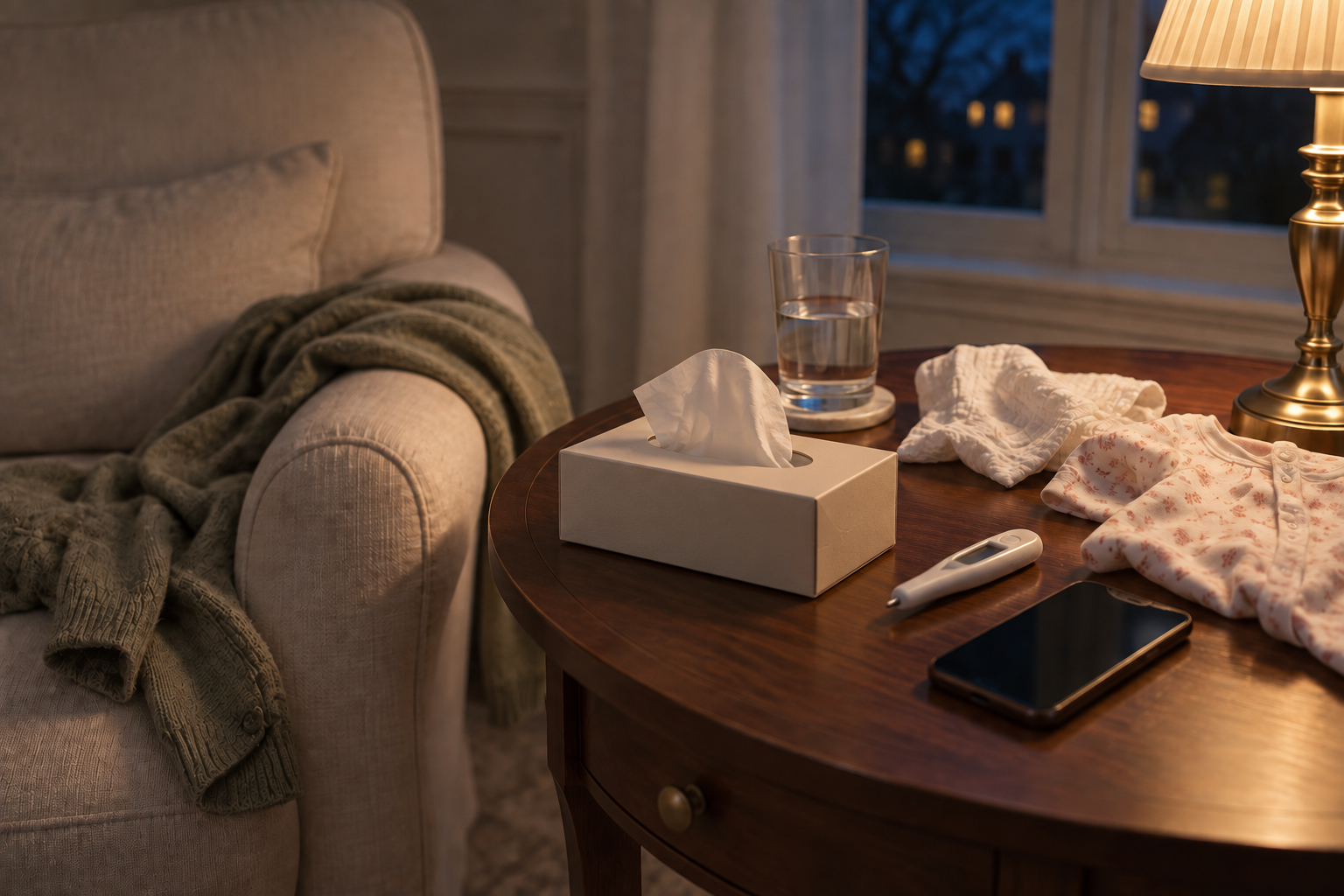
On a night when your baby is unwell, the house can feel very small. There is the light beside the chair, the thermometer, the next feed. The laundry is still where you left it, but your attention has moved somewhere else entirely.
These are the nights when the ordinary rhythm of home needs a little room to bend. A quieter room, familiar comfort, and fewer expectations can make space for the care your baby needs—and for you, the tired parent giving it.
First, a note that cannot wait: if your baby is 3 months old or younger and has a rectal temperature of 100.4°F / 38°C or higher, contact a pediatrician immediately for assessment, even if they seem otherwise well. Use a thermometer rather than touch alone to check a suspected fever. American Academy of Pediatrics
This is a gentle companion to your pediatrician’s advice, not a treatment plan. The small comforts below belong alongside medical care whenever it is needed.
Make room for closeness
A familiar voice, a hand resting gently on their back, a cuddle while you are fully awake: comfort can be simple. There is no need to turn the evening into an activity or persuade a tired baby to be cheerful.
Let the room be quiet enough to hear what they need. Some moments may call for holding; others, for putting them down and sitting nearby. Affection offers reassurance, but it does not treat the cause of a fever.
Offer fluids that fit their age
For babies under 6 months, offer breast milk or formula, not extra water unless a clinician directs otherwise. From around 6 months, small amounts of water can complement their usual milk feeds. If intake drops or wet diapers become noticeably fewer, contact your pediatrician promptly. AAP hydration guidance
Keep the things you need for feeding within reach. A clean cloth and one less trip across the room are small kindnesses to yourself, too.
Keep the room comfortable
Choose soft lamplight that still lets you see your baby clearly. Turn down background noise and let messages wait. Your home does not need to look peaceful for you to make one corner feel a little calmer.
Avoid extra layers and heavy bedding; do not use cold baths or sponging to lower a fever. Check on your child regularly, including overnight. NHS fever guidance
Let the schedule soften, while keeping sleep safe
The usual bedtime routine may be shorter tonight. A skipped story or unfinished kitchen does not need making up for.
For infants, keep sleep on their back in their own firm, flat crib or bassinet, with only a fitted sheet. Keep pillows, loose blankets, and toys out. If you feel sleepy while holding your baby, put them in that safe sleep space; do not sleep together on a sofa or armchair. AAP safe-sleep guidance
If another trusted adult is available, ask them to take a turn. You do not need to prove your love by staying awake alone.
Know when to ask for help
Seek emergency help for difficulty breathing, blue or gray lips, difficulty waking, a first seizure, or a rash that does not fade under pressure. Seek medical advice promptly for poor feeding, dehydration, worsening symptoms, or concern. NHS warning signs
For babies aged 3–6 months, contact your pediatrician early about a fever; the AAP advises notifying them at 101°F / 38.3°C or higher. Do not wait for a temperature threshold if your child seems unwell. AAP fever guidance
A short note of temperatures, how they were measured, feeds, wet diapers, and any medicine already given can help you explain the night clearly. Ask the clinician what changes to watch for and when to call again if the fever continues.
A Little Note from the Cottage
“The dishes can stay in the sink tonight. Let someone bring you water, find the clean pajamas, or answer the message you cannot get to. Caring for a little one takes attention, and it is all right for the rest of the house to wait.
You can be loving and worried at the same time. You can offer comfort and ask for help. There is room for both.”