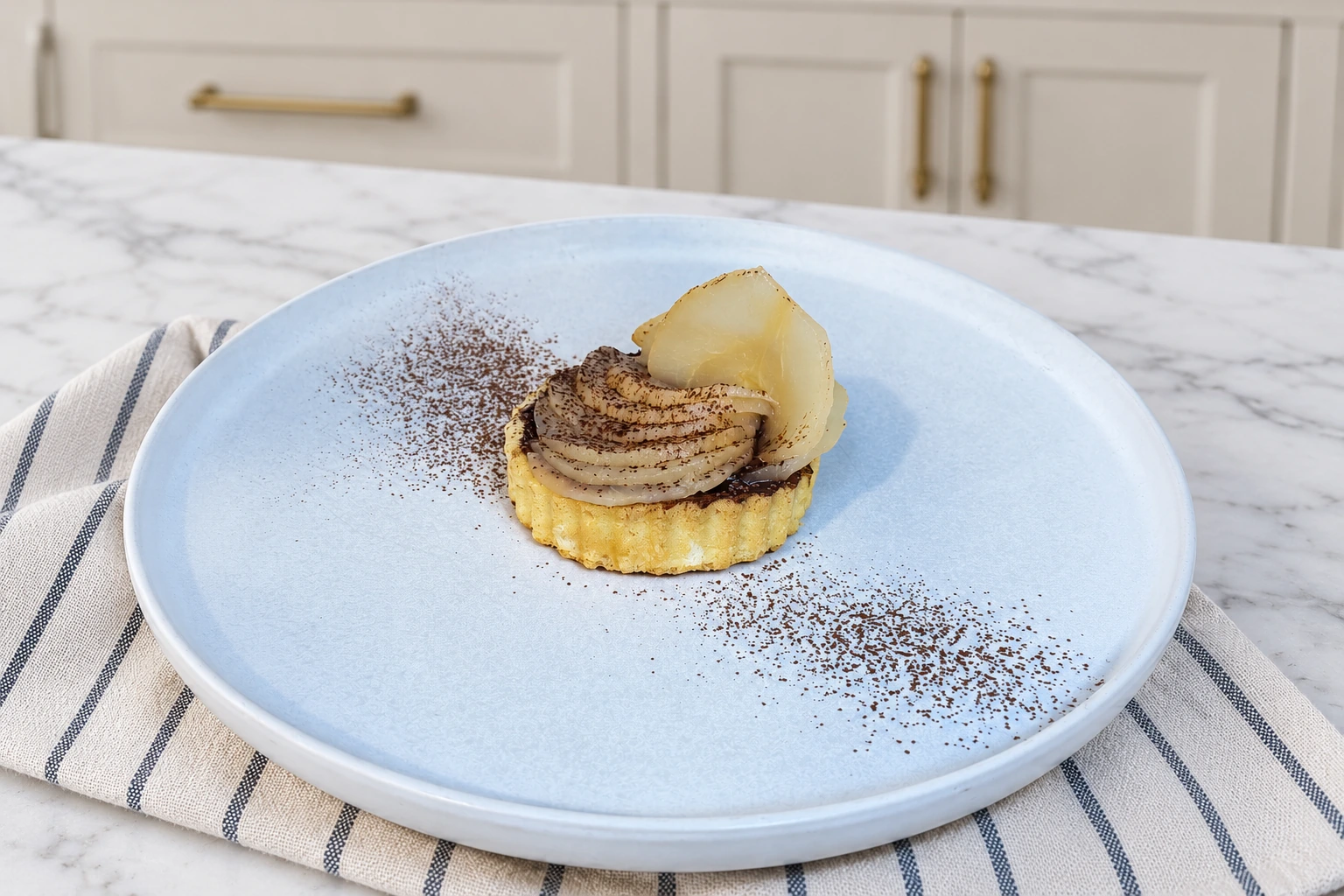
There are certain flavors I find myself returning to as the days turn cooler. Pear and chocolate is one of them: the gentle sweetness of the fruit complements the cocoa, while a little vanilla brings everything together.
These tartlets begin with a crisp, buttery pastry shell, filled with smooth chocolate ganache and finished with pears gently browned in butter. I like to leave some of the chocolate showing beneath the fruit and let each tartlet look a little different—that simple, homemade finish is part of their charm.
They are the sort of small dessert I imagine bringing to the table when the coffee is freshly brewed and there is still plenty to talk about. The shells and filling can be prepared ahead, leaving only the pears to arrange before serving.
The Recipe
Yield: Approximately 8 tartlets, each 3⅛ inches (8 cm) across
Active preparation: Approximately 45 minutes
Pastry chilling: 1 hour, plus 25–30 minutes after lining the pans
Baking: 22–30 minutes
Pear cooking time: 8–12 minutes per batch
Ganache chilling: 2–3 hours
Total time: Approximately 5–6 hours, including chilling and cooling
Ingredients
For the tartlet shells
- 220 g all-purpose flour
- 60 g powdered sugar, sifted
- 110 g unsalted butter, cold and cubed
- 1 large egg, approximately 50 g without the shell
- ½ teaspoon vanilla extract
- ¼ teaspoon fine salt
- Cold water, only if needed to bring the dough together
For the chocolate ganache
- 200 g semisweet chocolate with 55–60% cocoa, finely chopped
- 200 ml unsweetened heavy whipping cream, approximately 35% milk fat
- A pinch of fine salt
For the vanilla pears
- 3 medium pears, ripe but firm, approximately 170–190 g each
- 20 g unsalted butter
- 15 g light brown sugar
- 1 teaspoon vanilla extract
- 1 teaspoon lemon juice
- A pinch of fine salt
Instructions
1. Make the pastry.
Combine the flour, powdered sugar, and salt in a large bowl. Add the cold butter and work it into the dry ingredients with a pastry cutter or your fingertips until the mixture resembles fine sand. Work quickly to keep the butter from softening too much.
Lightly beat the egg with the vanilla and add it to the bowl. Mix with a spatula, then gently press the dough together with your hands. Avoid kneading.
If the dough still crumbles when pressed, add cold water one teaspoon at a time, using only enough to bring it together. The dough should hold its shape without feeling sticky.
Shape into a disc, wrap, and refrigerate for at least 1 hour.
2. Line the tartlet pans.
If the chilled dough is too firm to roll, let it stand at room temperature for a few minutes.
Roll between two sheets of parchment paper to an even thickness of 2.5–3 mm, approximately ⅛ inch. Cut circles approximately 4¾–5⅛ inches (12–13 cm) across to fit tartlet pans measuring 3⅛ inches (8 cm) across and ¾ inch (2 cm) deep.
Gently ease the dough into the pans, pressing it against the bottoms and into the corners without stretching. Trim the edges flush with the rims.
Press the scraps together without kneading and reroll as needed. Chill the dough again if it becomes soft.
Place the lined pans on a baking sheet and refrigerate for 25–30 minutes.
3. Bake the shells.
Preheat a conventional oven to 350°F (175°C).
Line each shell with parchment paper and fill with pie weights, dried rice, or dried beans. Distribute the weights against the sides as well as across the bottoms to help support the pastry.
Bake for 15–18 minutes, until the edges are firm and beginning to color.
Carefully remove the parchment and weights. Bake for another 7–12 minutes, until the bottoms look dry and the shells are golden.
Let cool in the pans for 10–15 minutes, then carefully unmold and transfer to a wire rack to cool completely.
4. Make the chocolate ganache.
Place the finely chopped chocolate in a heatproof bowl.
Heat the cream in a small saucepan over medium heat until steaming, with small bubbles appearing around the edges. Remove from the heat before it reaches a vigorous boil.
Pour the hot cream over the chocolate and let stand for 2 minutes.
Stir slowly with a spatula, beginning in the center and gradually working outward, until the ganache is smooth and glossy. Stir in the salt.
Let cool for approximately 15–20 minutes, stirring occasionally. It should remain pourable but no longer feel hot.
5. Fill and chill.
Divide the ganache among the completely cooled shells, leaving a little space below the rims for the pears. Depending on the shape of your pans, you may have a small amount of ganache left over.
Refrigerate for 2–3 hours, or until the filling has set. Keep the tartlets in a covered container with enough clearance so the lid does not touch the chocolate.
6. Cook the pears.
While the ganache sets, peel and quarter the pears, then remove the cores. Cut each quarter into three evenly sized wedges and gently toss with the lemon juice.
Melt the butter in a large skillet over medium heat. Add the pears in a single layer. If they do not fit comfortably, cook in two batches, dividing the butter, sugar, salt, and vanilla between them.
Cook for 3–4 minutes without moving the pears too much, until lightly golden underneath. Turn carefully, sprinkle with the brown sugar and salt, and cook for another 3–5 minutes, until tender but still holding their shape.
Reduce the heat and add the vanilla. Cook briefly, until the juices lightly coat the fruit. If the sugar begins to darken before the pears are tender, add a teaspoon of water.
Transfer the pears to a wide plate, leaving any excess liquid in the skillet. Let cool completely. If preparing ahead, cover and refrigerate until ready to assemble.
7. Finish and serve.
Shortly before serving, arrange four or five pear wedges over each tartlet, overlapping them slightly and leaving some chocolate visible.
Use a small spatula to lift the pears onto the ganache, avoiding any pooled cooking juices.
Let the tartlets stand at room temperature for approximately 15–20 minutes before serving so the filling softens slightly.
Choosing the Pears and Chocolate
Choose pears that are ripe enough to taste sweet but firm enough to hold their shape in the skillet. Very soft pears can break apart before they develop color.
For the ganache, use a baking chocolate bar with 55–60% cocoa. This gives the filling a balanced chocolate flavor and a soft, creamy texture once it has chilled and then rested briefly at room temperature. A higher cocoa percentage will make it firmer and more intense. Milk and white chocolate require different proportions of cream.
A Few Details That Make a Difference
- Bake the shells fully. The assembled tartlets will not return to the oven, so the pastry bottoms should be dry and golden before filling.
- Cool each component. The shells should be completely cool before adding the ganache, and the pears should be cool before placing them on the chocolate.
- Stir the ganache gently. A spatula helps create a smooth filling without introducing unnecessary air bubbles.
- Leave excess pear juices behind. The fruit should be lightly glazed rather than dripping with liquid.
- Add the pears close to serving. This helps preserve the appearance of the ganache and the texture of the pastry.
Preparing Ahead
To spread out the preparation, bake the shells and fill them with ganache the day before serving. Once the filling has set, keep the tartlets covered in the refrigerator.
Cook the pears separately, cool them completely, and refrigerate in a covered container. Arrange them on the tartlets shortly before serving.
For extra protection against moisture, brush the insides of the baked, cooled shells with a very thin layer of melted chocolate and let it set before adding the ganache. This slows softening, though the pastry will still be at its crispest when freshly assembled.
A Little Note from the Cottage
“Arrange the pears along the curve of each tartlet and let a little chocolate show beneath them. The softly glazed fruit and golden pastry edges need very little embellishment. I would bring them to the table on small dessert plates, pour the coffee, and leave a little room in the afternoon to linger.”